Omnichannel Broadcasts — Developer Guide & Admin UI
1. Installation & Peer Setup
Section titled “1. Installation & Peer Setup”pnpm add @vicacha-devs/strapi-plugin-broadcasts2. Server Configuration (config/plugins.ts)
Section titled “2. Server Configuration (config/plugins.ts)”Add the plugin configuration to your Strapi v5 config/plugins.ts file:
export default ({ env }: { env: (key: string, defaultValue?: string) => string }) => ({ "broadcasts": { enabled: true, config: { defaultSenderName: env("BROADCASTS_SENDER_NAME", "Community Hub"), dryRun: false, }, },});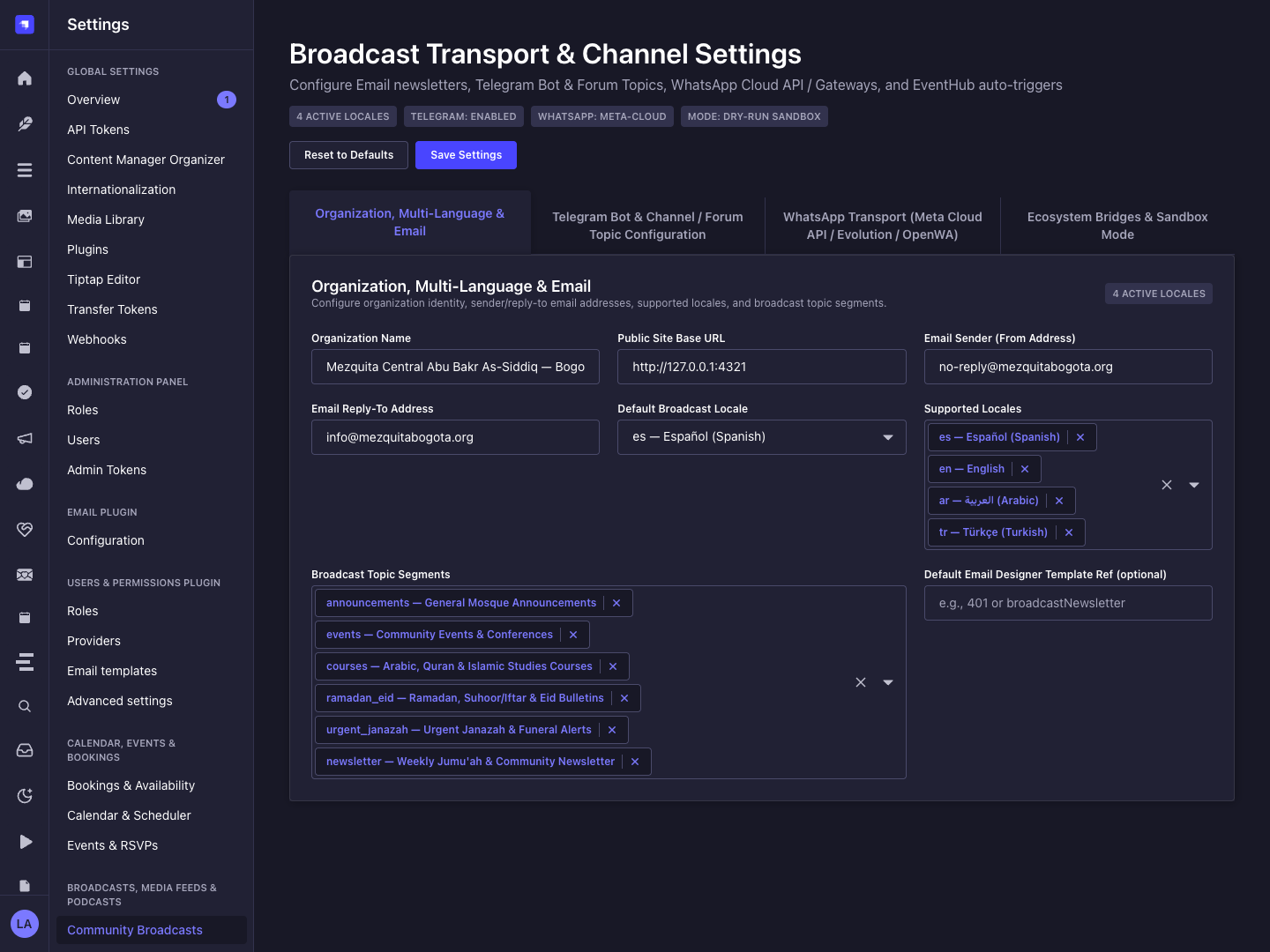
3. Strapi v5 Admin UI Tour
Section titled “3. Strapi v5 Admin UI Tour”Once enabled, the plugin registers its workspace and settings inside the Strapi v5 Admin panel using Strapi Design System v2 components:
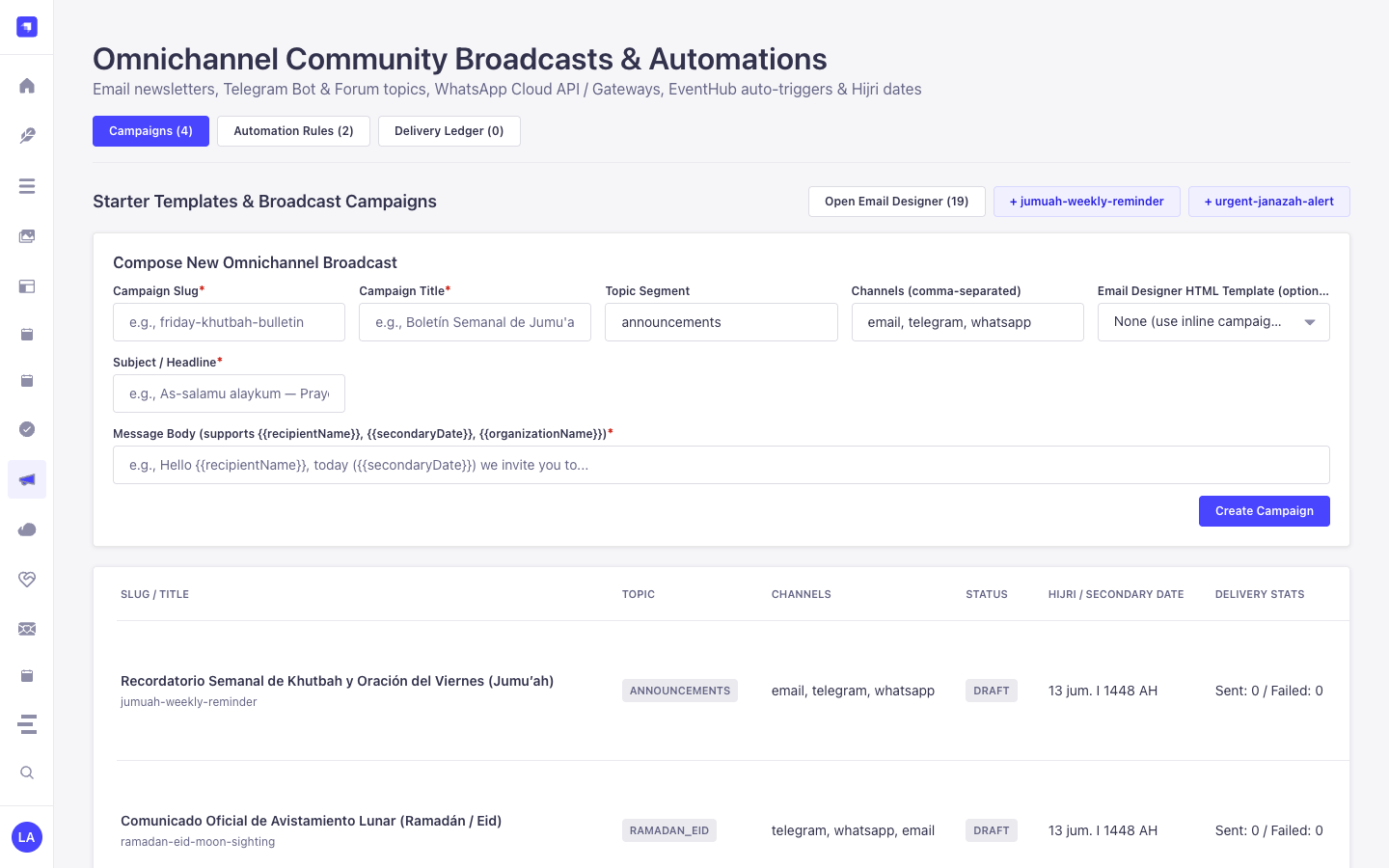
Key Localized Admin UI Labels
Section titled “Key Localized Admin UI Labels”| Translation Key | Rendered UI Label |
|---|---|
checkbox.enable_dry_run_sandbox_mode |
Enable Dry-Run Sandbox Mode |
checkbox.enable_email_designer_5_html_template_bridge |
Enable Email Designer 5 HTML Template Bridge |
checkbox.enable_eventhub_auto_broadcast_triggers |
Enable EventHub Auto-Broadcast Triggers |
checkbox.enable_telegram_transport |
Enable Telegram Transport |
checkbox.enable_whatsapp_transport |
Enable WhatsApp Transport |
checkbox.segment_confirmed_subscribers_via_inbox_bridge |
Segment confirmed subscribers via Inbox Bridge |
common.activate |
Activate |
common.active |
active |
4. Content-Type Entities, Locations & Schemas (strapi.documents)
Section titled “4. Content-Type Entities, Locations & Schemas (strapi.documents)”Registers three Collection Types (plugin::broadcasts.campaign, plugin::broadcasts.automation-rule, plugin::broadcasts.delivery-log). Campaigns store multi-channel message payloads; Automation Rules subscribe to Strapi eventHub events (e.g., entry.publish); Delivery Logs store idempotent (idempotencyKey), PII-masked (recipientMasked) audit trails. Supports schemaExtensions in config/plugins.ts.
Where to Find Content-Type Entities in Strapi v5
Section titled “Where to Find Content-Type Entities in Strapi v5”- Content Manager:
/admin/content-manager/collection-types/plugin::broadcasts.campaign,plugin::broadcasts.automation-rule, andplugin::broadcasts.delivery-log(visible: true) - Content-Type Builder:
/admin/plugins/content-type-builderunder Collection Types - Plugin Workspace & Settings:
/admin/plugins/broadcasts(Campaigns, Automation Rules, Delivery Audit) and/admin/settings/broadcasts - Database Tables:
broadcast_campaigns,broadcast_automation_rules, andbroadcast_delivery_logs
plugin::broadcasts.automation-rule — Broadcast Automation Rule
Section titled “plugin::broadcasts.automation-rule — Broadcast Automation Rule”EventHub-driven automated multi-channel broadcast rule
Kind:
collectionType· DB Table:broadcast_automation_rules· Admin Location:/admin/content-manager/collection-types/plugin::broadcasts.automation-rule· Draft & Publish:No· i18n:No
| Attribute | Strapi Type | Required | Constraints / Target |
|---|---|---|---|
name |
string |
Yes | — |
slug |
uid |
Yes | — |
eventName |
string |
Yes | — |
targetContentType |
string |
No | — |
topic |
string |
Yes | default: "announcements" |
channels |
json |
Yes | default: ["telegram"] |
active |
boolean |
No | default: true |
priority |
enumeration |
No | enum: low, normal, high, urgent; default: "normal" |
subjectTemplate |
string |
Yes | — |
bodyTextTemplate |
text |
Yes | — |
bodyHtmlTemplate |
richtext |
No | — |
ctaLabelTemplate |
string |
No | — |
ctaUrlTemplate |
string |
No | — |
translations |
json |
No | default: {} |
lastTriggeredAt |
datetime |
No | — |
triggerCount |
integer |
No | default: 0 |
plugin::broadcasts.campaign — Broadcast Campaign
Section titled “plugin::broadcasts.campaign — Broadcast Campaign”Omnichannel Email, Telegram & WhatsApp broadcast campaign
Kind:
collectionType· DB Table:broadcast_campaigns· Admin Location:/admin/content-manager/collection-types/plugin::broadcasts.campaign· Draft & Publish:No· i18n:No
| Attribute | Strapi Type | Required | Constraints / Target |
|---|---|---|---|
title |
string |
Yes | — |
slug |
uid |
Yes | — |
topic |
string |
Yes | default: "announcements" |
channels |
json |
Yes | default: ["email","telegram"] |
priority |
enumeration |
Yes | enum: low, normal, high, urgent; default: "normal" |
status |
enumeration |
Yes | enum: draft, scheduled, sending, sent, failed, cancelled; default: "draft" |
scheduledAt |
datetime |
No | — |
sentAt |
datetime |
No | — |
subject |
string |
Yes | — |
bodyText |
text |
Yes | — |
bodyHtml |
richtext |
No | — |
ctaLabel |
string |
No | — |
ctaUrl |
string |
No | — |
mediaUrl |
string |
No | — |
emailTemplateRef |
string |
No | — |
whatsappTemplateName |
string |
No | — |
whatsappGroupIds |
json |
No | default: [] |
telegramChatId |
string |
No | — |
telegramThreadId |
integer |
No | — |
translations |
json |
No | default: {} |
secondaryDate |
json |
No | default: {} |
secondaryDateLabel |
string |
No | — |
stats |
json |
No | default: {} |
metadata |
json |
No | default: {} |
plugin::broadcasts.delivery-log — Broadcast Delivery Log
Section titled “plugin::broadcasts.delivery-log — Broadcast Delivery Log”Idempotent, PII-masked multi-channel delivery audit log
Kind:
collectionType· DB Table:broadcast_delivery_logs· Admin Location:/admin/content-manager/collection-types/plugin::broadcasts.delivery-log· Draft & Publish:No· i18n:No
| Attribute | Strapi Type | Required | Constraints / Target |
|---|---|---|---|
idempotencyKey |
string |
Yes | — |
campaignSlug |
string |
Yes | — |
channel |
enumeration |
Yes | enum: email, telegram, whatsapp |
driver |
string |
Yes | — |
recipientMasked |
string |
Yes | — |
locale |
string |
Yes | default: "es" |
status |
enumeration |
Yes | enum: sent, simulated, skipped_duplicate, failed |
externalMessageId |
string |
No | — |
errorMessage |
text |
No | — |
sentAt |
datetime |
Yes | — |
secondaryDateLabel |
string |
No | — |
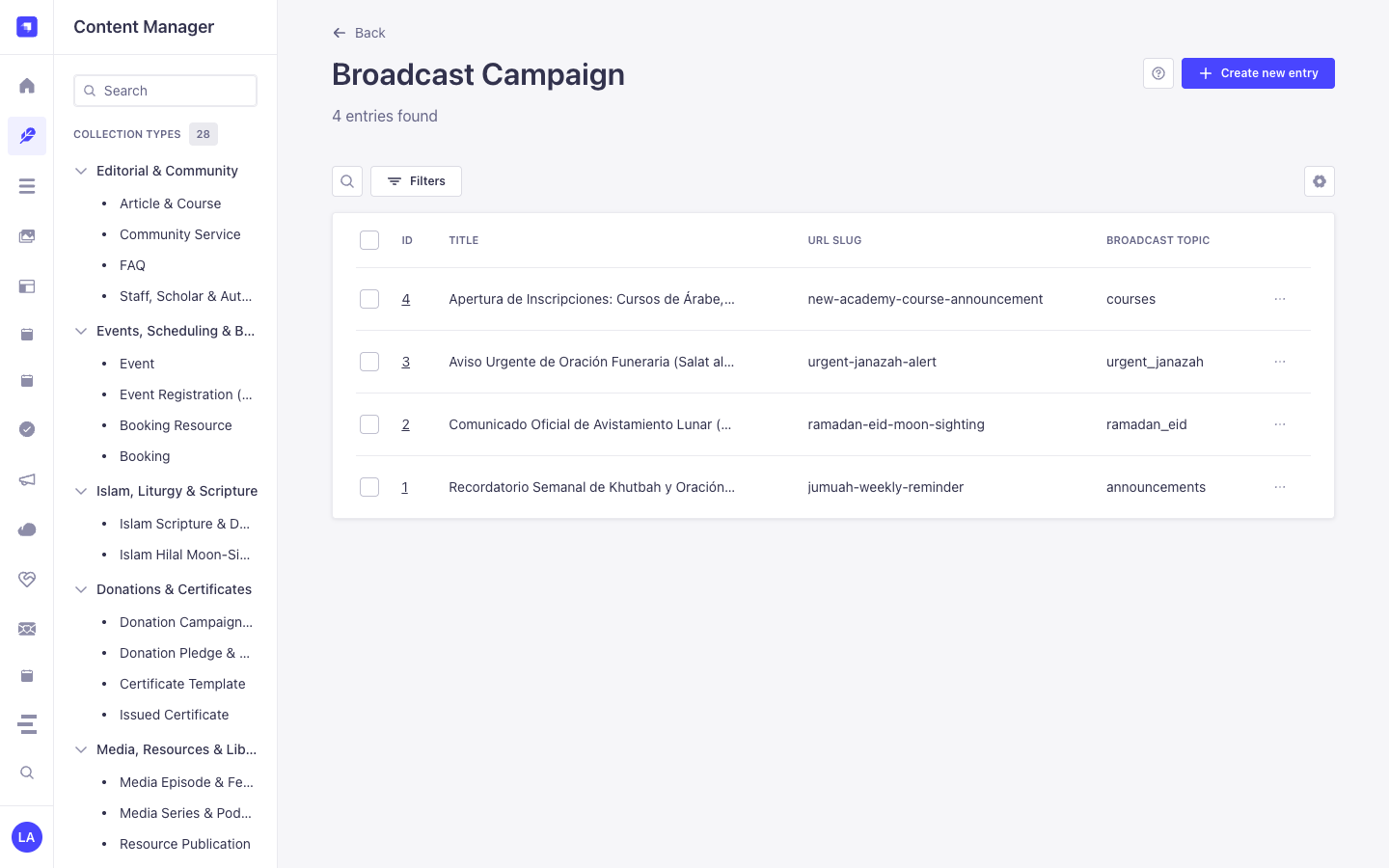
Strapi v5 Content Manager Integration (/admin/content-manager)
Section titled “Strapi v5 Content Manager Integration (/admin/content-manager)”Content Manager Sidebar Group:
Inbox & Omnichannel Broadcasts
Content Manager Entities & Components
Section titled “Content Manager Entities & Components”plugin::broadcasts.campaign(Broadcast Campaign —/admin/content-manager/collection-types/plugin::broadcasts.campaign)plugin::broadcasts.automation-rule(Broadcast Automation Rule —/admin/content-manager/collection-types/plugin::broadcasts.automation-rule)plugin::broadcasts.delivery-log(Broadcast Delivery Log —/admin/content-manager/collection-types/plugin::broadcasts.delivery-log)
Why This Plugin Creates & Integrates Content Manager Entities
Section titled “Why This Plugin Creates & Integrates Content Manager Entities”@vicacha-devs/strapi-plugin-broadcasts exposes all three of its entities (Broadcast Campaign, Broadcast Automation Rule, and Broadcast Delivery Log) in the Strapi v5 Content Manager so communication teams can author rich campaign payloads, audit PII-masked delivery logs, and govern access via native RBAC:
- Structured Campaign Authoring & Review: Draft
bodyHtml,bodyText,telegramParseMode,whatsappTemplateName, andctaUrlin Content Manager with collaborative@vicacha-devs/strapi-plugin-notesannotations before dispatching from/admin/plugins/broadcasts. - Declarative EventHub Rule Management: Inspect and bulk-toggle
Broadcast Automation Rule(plugin::broadcasts.automation-rule) triggers (entry.publish,entry.create) and Mustache templates ({{title}},{{slug}}) in Content Manager. - Compliance & Delivery Log Auditing: Filter
Broadcast Delivery Log(plugin::broadcasts.delivery-log) bychannel,status(sent,failed,skipped_duplicate),idempotencyKey, andrecipientMaskedusing Content Manager’s native search and pagination. - Role-Based Access Separation: Grant copywriters Content Manager permission to draft
plugin::broadcasts.campaignrecords while restricting actual live dispatch (POST /broadcasts/campaigns/{id}/send) to senior administrators.
How to Use in Strapi Content Manager (Step-by-Step)
Section titled “How to Use in Strapi Content Manager (Step-by-Step)”- Open in Content Manager: Navigate to Content Manager -> Collection Types -> Inbox & Omnichannel Broadcasts and select Broadcast Campaign, Broadcast Automation Rule, or Broadcast Delivery Log.
- Author & Schedule Campaigns: In Broadcast Campaign (
/admin/content-manager/collection-types/plugin::broadcasts.campaign), create an entry withtitle,slug,topic,targetLocale,channels(['email', 'telegram', 'whatsapp']), and channel-specific templates. - Configure EventHub Automation Rules: In Broadcast Automation Rule (
/admin/content-manager/collection-types/plugin::broadcasts.automation-rule), bindeventName(entry.publish) andtargetContentType(e.g.,plugin::events.eventorplugin::islam.hilal-announcement). - Workspace vs. Content Manager: Use Content Manager to draft campaign copy, attach review notes, and query
Broadcast Delivery Loghistory; use the Broadcasts Workspace (/admin/plugins/broadcasts) to execute dry-run previews and trigger live omnichannel sends.
Content Manager & Plugin Workspace Synchronization
Section titled “Content Manager & Plugin Workspace Synchronization”Content Manager Use Cases & Editorial Workflows
Section titled “Content Manager Use Cases & Editorial Workflows”Content Manager Use Case 1 — Two-Stage Editorial Approval Before Omnichannel Dispatch
Section titled “Content Manager Use Case 1 — Two-Stage Editorial Approval Before Omnichannel Dispatch”- Why & What it is for: Allow editors to prepare multilingual campaign copy and WhatsApp template variables in Content Manager while a reviewer leaves approval notes before sending.
- How to use in Content Manager: Create a
Broadcast Campaignwithstatus: 'draft'in/admin/content-manager/collection-types/plugin::broadcasts.campaign, review it via the Content Manager Notes panel, and dispatch it from/admin/plugins/broadcasts.
Content Manager Use Case 2 — Filtering Failed or Skipped Delivery Logs by Channel & Campaign
Section titled “Content Manager Use Case 2 — Filtering Failed or Skipped Delivery Logs by Channel & Campaign”- Why & What it is for: Investigate delivery failures or idempotent duplicate skips across Email, Telegram, and WhatsApp without exposing raw subscriber PII.
- How to use in Content Manager: Open
/admin/content-manager/collection-types/plugin::broadcasts.delivery-logand filter bystatus = failedorchannel = whatsappto inspecterrorMessageandrecipientMasked.
5. End-to-End Use Cases & Workflows
Section titled “5. End-to-End Use Cases & Workflows”Use Case 1 — Omnichannel Manual & Scheduled Community Campaigns
Section titled “Use Case 1 — Omnichannel Manual & Scheduled Community Campaigns”- What it is for: Dispatch announcements simultaneously across Email (SMTP/Resend), Telegram Bot channels/threads, and WhatsApp Cloud API.
- How it works: Create a
plugin::broadcasts.campaignentity withchannels: ['email', 'telegram', 'whatsapp'], preview viaPOST /broadcasts/campaigns/{id}/dry-run, and dispatch viaPOST /broadcasts/campaigns/{id}/send.
Use Case 2 — EventHub Zero-Touch Publish Automation
Section titled “Use Case 2 — EventHub Zero-Touch Publish Automation”- What it is for: Automatically broadcast a Telegram/WhatsApp notification whenever an editor publishes a new Event, Hilal Announcement, or Urgent Campaign.
- How it works: Create a
plugin::broadcasts.automation-ruleentity matchingeventName: 'entry.publish'andtargetContentType: 'plugin::events.event'with Mustache-stylesubjectTemplateandbodyTextTemplate.
Use Case 3 — Idempotent PII-Masked Delivery Auditing
Section titled “Use Case 3 — Idempotent PII-Masked Delivery Auditing”- What it is for: Guarantee no subscriber receives duplicate messages on retry while keeping phone numbers and emails masked in database logs.
- How it works: Every dispatch computes a deterministic
idempotencyKeyrecorded inplugin::broadcasts.delivery-logwithrecipientMasked(j***@example.org,+57***4821).
6. REST API Endpoints (content-api & admin)
Section titled “6. REST API Endpoints (content-api & admin)”| Method | Endpoint Path | Scope | Controller Handler | Auth |
|---|---|---|---|---|
GET |
/api/broadcasts/public/channels |
content-api |
broadcastController.listPublicChannels |
Public |
GET |
/api/broadcasts/public/archive |
content-api |
broadcastController.listPublicArchive |
Public |
GET |
/broadcasts/settings |
admin |
broadcastController.getSettings |
Bearer JWT |
PUT |
/broadcasts/settings |
admin |
broadcastController.updateSettings |
Bearer JWT |
GET |
/broadcasts/templates |
admin |
broadcastController.listStarterTemplates |
Bearer JWT |
GET |
/broadcasts/email-templates |
admin |
broadcastController.listEmailTemplates |
Bearer JWT |
GET |
/broadcasts/campaigns |
admin |
broadcastController.listCampaigns |
Bearer JWT |
POST |
/broadcasts/campaigns |
admin |
broadcastController.createCampaign |
Bearer JWT |
PUT |
/broadcasts/campaigns/{documentId} |
admin |
broadcastController.updateCampaign |
Bearer JWT |
POST |
/broadcasts/campaigns/from-template |
admin |
broadcastController.createFromTemplate |
Bearer JWT |
POST |
/broadcasts/campaigns/{documentId}/send |
admin |
broadcastController.sendCampaign |
Bearer JWT |
GET |
/broadcasts/automation-rules |
admin |
broadcastController.listAutomationRules |
Bearer JWT |
POST |
/broadcasts/automation-rules |
admin |
broadcastController.createAutomationRule |
Bearer JWT |
PUT |
/broadcasts/automation-rules/{documentId} |
admin |
broadcastController.updateAutomationRule |
Bearer JWT |
GET |
/broadcasts/delivery-logs |
admin |
broadcastController.listDeliveryLogs |
Bearer JWT |
7. Programmatic Server Usage (strapi.plugin & strapi.documents)
Section titled “7. Programmatic Server Usage (strapi.plugin & strapi.documents)”// Registered services on plugin "broadcasts": "settings", "transportService", "campaignService", "automationService"const pluginService = strapi.plugin("broadcasts")?.service("transportService");
// Querying records via the Strapi v5 Document Service APIconst records = await strapi.documents("plugin::broadcasts.automation-rule").findMany({ limit: 25, sort: "createdAt:desc",});8. Troubleshooting & Verification
Section titled “8. Troubleshooting & Verification”- Admin panel changes not visible: Run
pnpm strapi buildafter modifyingconfig/plugins.ts. - Peer dependency isolation: Keep
hoistPattern: ["*", "!@strapi/*"]inpnpm-workspace.yamlso@strapi/*contexts are never duplicated. - TypeScript type-checking: Validate both
admin/tsconfig.jsonandserver/tsconfig.jsonviapnpm --filter <pkg> test:ts.